It’s the first question almost every learner asks us: “What JLPT level do I need to get a job in Japan?”
And almost everywhere you look online, you’ll get a single, confident-sounding answer — usually “N3” or “N2.” The problem is that there is no single answer. The level you need depends entirely on which route into Japan you take, and in 2026 several of those routes changed in ways that most India-facing websites haven’t updated for yet.
So instead of giving you a number and hoping it fits, this guide does something more useful: it maps the actual routes Indians use to work in Japan, tells you the Japanese level each one genuinely requires, and flags what’s changed this year. Every figure here is checked against official Japanese government sources, which we’ve linked at the end. Think of it as a decision tool, not a sales pitch.
One honest note before we start, because it shapes everything below.
Language is a gate, not a guarantee
Passing a JLPT level does not, by itself, get you a job in Japan. What it does is unlock a door — it makes you eligible for a route, or makes your application competitive. You still need the other pieces: the right degree or skill, a genuine job offer from a Japanese employer, and a visa (residence status) that matches the work.
We say this plainly because it protects you from a common and expensive mistake — spending a year chasing N2 for a route that only needs N4, or assuming a certificate alone is a ticket. Language is necessary. It is rarely sufficient on its own. Keep that frame in mind and the rest of this becomes much clearer.
The five routes — and the level each one needs
1. The Engineer / Specialist visa (技人国 · Gijinkoku) — the main white-collar route
If you’re an IT professional, engineer, translator, designer, marketer, or graduate looking for a skilled desk job, this is almost certainly your route. Its full name is Engineer / Specialist in Humanities / International Services, and it’s one of the most widely held work statuses in Japan — around 475,000 people held it at the end of 2025, second only to permanent residents.
What it requires: a bachelor’s degree in a field that matches your job duties (for IT engineers, an approved IT certification can stand in for the degree), a job offer, and pay on par with a Japanese national in the same role.
Japanese level — and here’s the 2026 change everyone gets wrong: Technically, this visa still has no Japanese-language requirement — the eligibility rules didn’t change. What changed for applications filed on or after 15 April 2026 is a new documentation step. If you’ll work in a language-based, customer-facing role (translation, interpretation, Japan-market marketing, certain sales roles) for a smaller, unlisted employer (Immigration “Category 3 or 4”), you must now submit proof of CEFR B2-level ability in your working language.
For Japanese, JLPT N2 is the standard way to prove that B2 level — but it is not the only one. A BJT (Business Japanese Test) score of 400+, a degree from a Japanese university or college, or having completed schooling in Japan also count. And crucially:
- Large and listed employers (Categories 1 and 2) don’t routinely have to submit this proof.
- Purely technical roles — including most IT engineering jobs — aren’t covered, because the work isn’t language-based.
So the sweeping headline “you now need N2 to work in Japan” is wrong on three counts: it’s a documentation rule rather than a new eligibility bar, it’s B2 in your working language (N2 is just the common proof), and it only touches language-facing roles at smaller firms. That said — for a Japan-facing job that actually runs in Japanese (client meetings, documentation, business email), N2 is exactly the level that makes you employable and application-ready, rule or no rule.
Realistic target: N3 to get shortlisted and function; N2 to be genuinely competitive for Japanese-language-heavy roles (and to satisfy the 2026 documentation rule where it applies).
2. The Specified Skilled Worker visa (特定技能 · SSW) — the skilled-labour route
This route exists for shortage sectors — nursing and elderly care, food and beverage manufacturing, construction, agriculture, hospitality, and more (now 19 fields in total for Type 1). Crucially, it does not require a university degree, which makes it the realistic path for many capable people the degree-based routes shut out.
Japanese level: for SSW Type 1, you pass either JLPT N4 or the JFT-Basic (A2) test, plus a sector-specific skills exam. Most candidates actually take JFT-Basic rather than JLPT, because it’s offered far more often and is built specifically for this visa — but JLPT N4 is fully accepted, and it’s the level Saachi teaches directly toward. Care-work applicants sit an additional nursing-care Japanese test.
A few honest details for 2026:
– SSW Type 1 runs up to five years and does not allow you to bring dependents. Type 2 (higher-skilled) has no formal language test, allows family, and opens a longer-term future — but you generally reach it through Type 1, not straight away.
– New applications in the food-service sub-field have been frozen since April 2026 because its intake cap was reached. Caps like this move; check the current position for your sector before committing.
– Pay typically runs around ¥176,000–¥250,000 a month, often with support like accommodation and insurance, at the same rate a Japanese worker in the role would receive.
Realistic target: N4 (or JFT-Basic A2). This is the single most achievable, well-defined language bar into Japan — and where a lot of Indian candidates should honestly be looking first.
3. Ikusei Shūrō (育成就労) — the new training-to-employment route from 2027
You may have read about the “Technical Intern Training Program” (TITP). It is being abolished and replaced by a new system called Ikusei Shūrō (“Employment for Skill Development”), effective 1 April 2027 (the law was passed in June 2024). The old programme drew heavy criticism; the new one is explicitly designed to develop and retain workers, allows limited job changes within the same field, and is built as a feeder into the SSW visa above.
Japanese level: entry is set around CEFR A1 — roughly a solid beginner / high-N5 footing — with the expectation that you build toward SSW Type 1 level (N4 / JFT-Basic) during the three-year programme. Intake is capped (about 426,000 places over the first five years) across 17 sectors.
Realistic target: strong N5 to start, then N4 while you’re there. If SSW is your destination, starting Japanese now puts you ahead of the 2027 opening.
4. Highly Skilled Professional — the fast track for senior talent
A points-based route for high earners and advanced qualifications, with perks like a faster path to permanent residency. Japanese proficiency isn’t strictly mandatory, but it earns you points — so N2/N1 can be the difference that tips you over the threshold or shortens your timeline. If you’re senior in IT, research, or management, this is worth investigating alongside the Engineer visa.
Realistic target: language is a bonus multiplier here — every level you gain helps.
5. The student visa — the underrated stepping stone
Not a work route by itself, but a well-worn on-ramp: study at a Japanese institution, build your Japanese to N2/N1 in-country, and convert to a work visa with a local job offer in hand. Slower and costlier, but for younger learners without a matching degree it can be the most reliable bridge of all.
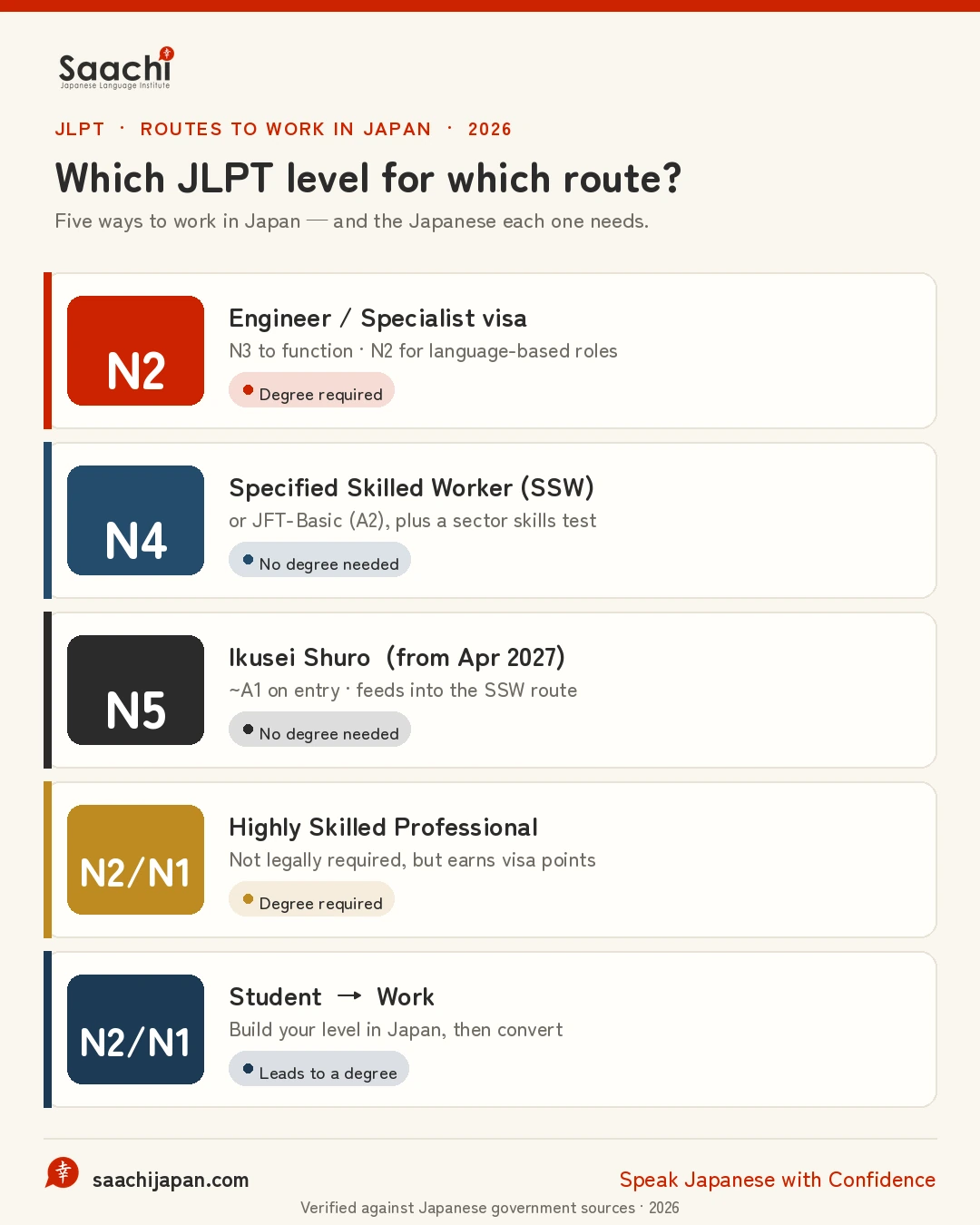
The one-glance summary
| Route | Best for | Japanese level you actually need | Degree required? |
|---|---|---|---|
| Engineer / Specialist (Gijinkoku) | IT, engineering, translation, graduates | N2 to prove B2 for language-based roles (2026 documentation rule); N3 to function. IT/technical roles: no minimum | Yes (IT cert can substitute) |
| Specified Skilled Worker (SSW) | Care, construction, food, hospitality | N4 or JFT-Basic (A2) + skills test | No |
| Ikusei Shūrō (from Apr 2027) | Entry into shortage sectors → SSW | ~A1 / high-N5 on entry, build to N4 | No |
| Highly Skilled Professional | Senior IT / research / management | Not required, but N2/N1 earns points | Yes |
| Student → Work | Younger learners, no matching degree | Build to N2/N1 in Japan | Route to a degree |
What most India-facing sites get wrong in 2026
Because this is exactly where the confusion comes from, let’s clear it up directly:
- “You need N3 for SSW.” No — SSW Type 1 is N4 or JFT-Basic. Asking for N3 sets the bar higher than the law does and can discourage people who are already eligible.
- “You now need N2 to work in Japan, full stop.” No — the April 2026 change is narrow and often overstated: it’s a documentation requirement (not a new eligibility rule), for language-based, customer-facing roles at smaller firms, proving B2 in your working language — and N2 is only one of several accepted proofs. Most IT engineers aren’t covered at all.
- “TITP is the way in.” TITP is being abolished (replaced by Ikusei Shūrō from April 2027). Advice built around the old programme is going out of date.
- “A JLPT certificate gets you the job.” It gets you eligible and competitive. You still need the degree/skill, the offer, and the matching visa.
None of this is meant to knock anyone — the rules genuinely changed fast this year. But when you’re planning months of study, being told the right number matters.
So what level should you aim for?
A quick way to decide:
- Graduate with a degree, targeting a skilled/desk job in Japan? Aim for N3, then N2 — N2 is what makes you employable for Japanese-language roles and satisfies the 2026 rule where it applies. Our N2 course includes a Business Communication module built for exactly this.
- No degree, but skilled and willing to work in a shortage sector? Aim for N4 (SSW’s bar) and don’t over-shoot. Start with a Beginner N5 foundation.
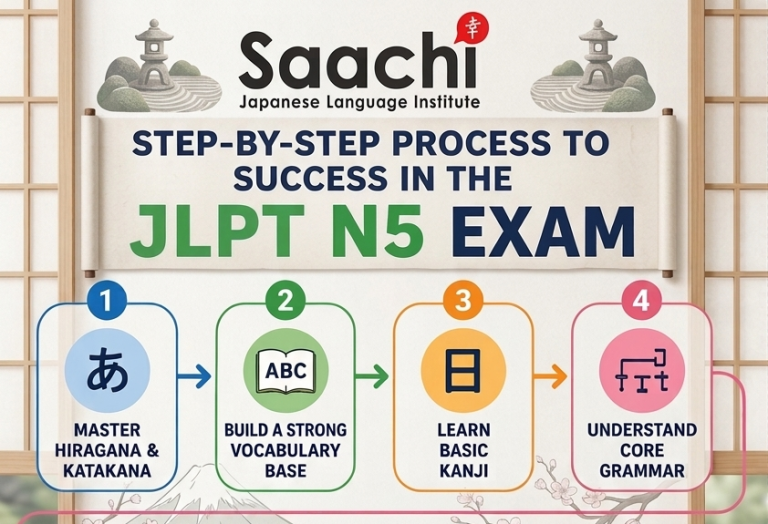
- Just starting and exploring? Build a solid N5 foundation first — it’s the base every single route above is built on, and it buys you time to choose your path. See all JLPT levels explained, or read why learning Japanese is worth it.
- In a specialised profession (say, medicine)? Rules can be very different — our post Can Indian Doctors Practice in Japan? walks through one such case.
Where Saachi fits in — honestly
We’re a Japanese-language institute, not a recruitment agency, and we won’t tell you we can place you in a job in Japan — no honest school can promise that. What we can do is get you, reliably and at your own pace, to the level each of these routes actually requires:
- N5 → N4 for the SSW and Ikusei Shūrō doors, taught with real conversation practice from native speakers.
- N3 → N2 for the skilled/Engineer route, with an N2 Business Japanese module aimed squarely at the workplace Japanese those roles run on.
With 9000+ students trained, 20+ years of experience, a 4.9★ rating and a 90% JLPT success rate, our job is to make the language the part of your Japan plan you never have to worry about. The rest — the degree, the offer, the visa paperwork — you’ll go after with clear eyes, knowing exactly which door you’re aiming for.
Speak Japanese with Confidence. Book a free demo or counselling session and we’ll help you pick the right level for your route — WhatsApp +91 95914 57722.
Frequently asked questions
What JLPT level do I need to work in Japan?
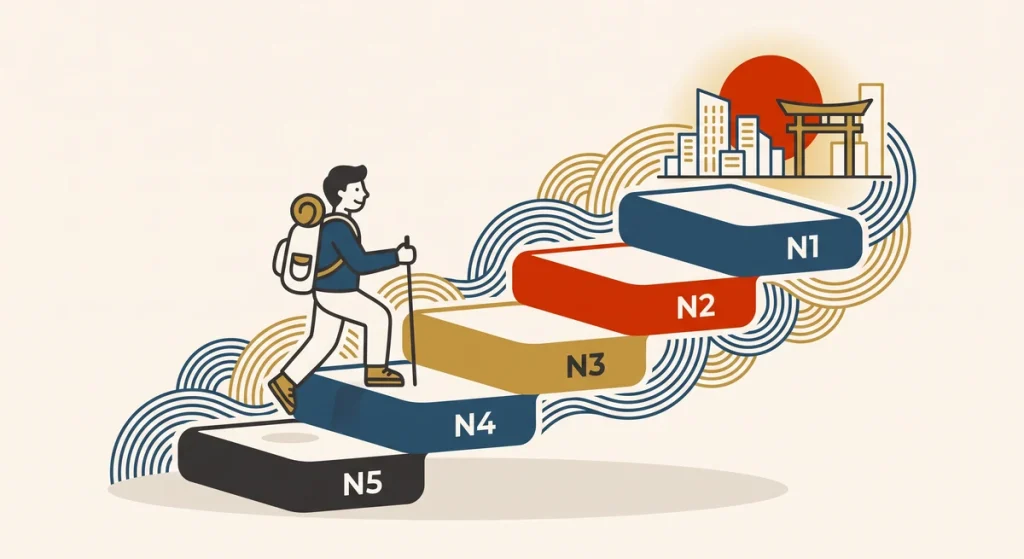
It depends on the route. Skilled-labour jobs on the SSW visa need JLPT N4 (or JFT-Basic). Skilled desk jobs on the Engineer/Specialist visa need N2 where the role is language-based (to satisfy a 2026 documentation rule), and N3 to function well; purely technical IT roles have no language minimum. There is no single “level to work in Japan.”
Is JLPT N4 enough to get a job in Japan?
For the Specified Skilled Worker (SSW) route in sectors like care, construction, food and hospitality, N4 (or JFT-Basic A2) is the required language level, alongside a skills test and a job offer. For skilled office roles, you’ll usually want N3–N2.
Did Japan really make N2 mandatory for work visas in 2026?
Not quite — this is widely overstated. From 15 April 2026, applicants for the Engineer/Specialist visa in language-based, customer-facing roles at smaller (unlisted) employers must submit proof of CEFR B2-level ability in their working language. JLPT N2 is one accepted proof (others include BJT 400+ or a Japanese degree). Large/listed companies and most technical IT roles are not affected. It is a documentation requirement, not a blanket “N2 for everyone” rule.
Is the Technical Intern Training Program (TITP) still an option?
It’s being phased out. Japan replaces TITP with the new Ikusei Shūrō (“Employment for Skill Development”) system from 1 April 2027, which needs about CEFR A1 (high-N5) on entry and feeds into the SSW route. Plan around the new system, not the old one.
Can Saachi place me in a job in Japan?
No — we’re a language institute, not a placement agency, and we don’t make job or placement promises. What we do is train you to the exact JLPT level your chosen route requires (N5 to N2), including workplace and business Japanese, so you’re ready when the right opportunity comes.
Official sources (verified July 2026)
Rules, caps and sector lists are updated by government notice — always confirm the current position for your specific sector and role directly with the official bodies below.
- Immigration Services Agency of Japan (ISA) — visa and residence-status authority: https://www.isa.go.jp/en/
- Specified Skilled Worker (SSW) official portal (ISA) — what SSW is, the language + skills tests, the fields: https://www.ssw.go.jp/en/ · overview: https://www.ssw.go.jp/en/about/visa/
- Japanese-Language Proficiency Test (JLPT) — official test site (Japan Foundation & JEES): https://www.jlpt.jp/e/
- JFT-Basic (Japan Foundation Test for Basic Japanese) — the A2 test accepted for SSW: https://www.jpf.go.jp/jft-basic/e/index.html
- Ministry of Health, Labour and Welfare (MHLW) — labour rules, Hello Work, Ikusei Shūrō: https://www.mhlw.go.jp/
The 15 April 2026 revision to the Engineer/Specialist in Humanities/International Services status is an ISA guideline change; for a plain-language professional summary, see EY Japan’s bilingual immigration bulletin (April 2026). Figures on holder numbers and intake caps are from ISA data as reported in 2025–2026.