
If you’re new to Japanese, one question comes up before any other: which JLPT level should I start with? It’s the right question to ask, because starting at the correct level is the difference between building steady momentum and feeling lost in your first month.
The good news is that the answer is usually simpler than people expect. This guide walks you through what each level actually means, what the JLPT measures (and what it doesn’t), and how to land in the batch that fits you — so you can begin learning with clarity instead of guesswork.
Not sure? Find your level in 20 minutes.
First, what is the JLPT?
The Japanese-Language Proficiency Test (JLPT) is the world’s most widely recognised test of Japanese ability for non-native speakers. It’s held twice a year, in July and December, and is graded across five levels — from N5 (the entry point) up to N1 (the most advanced).
At Saachi, we prepare learners across the four levels that most students work through: N5, N4, N3 and N2.
One thing that surprises many first-time learners: the JLPT tests reading and listening comprehension. It does not have a spoken or handwritten-essay section. That doesn’t mean speaking is unimportant — quite the opposite. But it does mean that choosing your level is really about matching the grammar, vocabulary and kanji you can comfortably recognise and understand, not how fluently you can chat yet.
The short answer: most beginners start at N5
If you’ve never formally studied Japanese, you start at N5. Full stop.
You don’t “skip ahead” to N3 or N2 simply because you’re motivated or a fast learner. Each level builds directly on the one before it — the grammar patterns, the kanji, the sentence structures all stack. Beginning at the right foundation is what makes the higher levels feel achievable later.
The learners who should consider starting higher are those who already have real prior exposure: someone who studied Japanese in school or college, lived in Japan, or has been self-studying for a while. If that’s you, a short placement check is the smart move (more on that below) so you join the batch that genuinely matches your current ability rather than one that’s too easy or too steep.
The four levels, explained
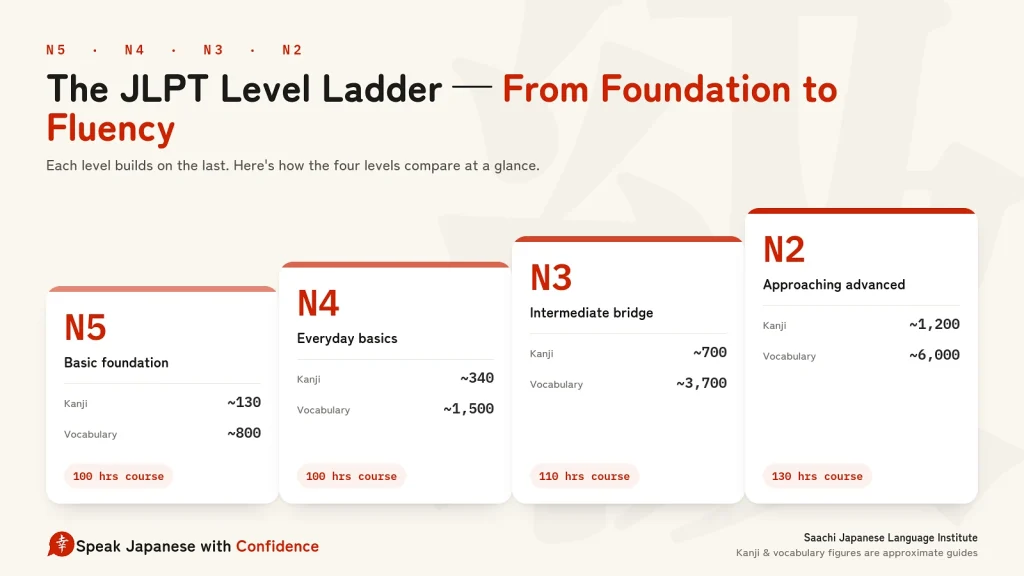
Here’s what each level means in practical terms — what you’ll be able to understand, and roughly how much vocabulary and kanji it involves. Treat the kanji and vocabulary figures as guides, not rigid quotas.
N5 — Your first foundation
Course length at Saachi: ~100 hours
N5 is where the language opens up. You’ll master both Japanese scripts — hiragana and katakana — and around 130 basic kanji with roughly 800 words of everyday vocabulary. By the end, you can read and understand set phrases and simple sentences, follow short, slow conversations about familiar topics, and introduce yourself in Japanese.
Best for: absolute beginners, and anyone who has never studied Japanese formally.
👉 Explore our Beginner Japanese (N5) course →
N4 — Everyday basics
Course length at Saachi: ~100 hours
N4 takes you from survival phrases to genuinely useful everyday Japanese. You’ll grow to about 340 kanji and roughly 1,500 words. You can follow conversations spoken at a natural but gentle pace, read passages on familiar daily topics, and handle a much wider range of situations.
Best for: learners who’ve completed N5 or already have a solid grasp of both scripts and basic grammar.
👉 Explore our Elementary Japanese (N4) course →
N3 — The intermediate bridge
Course length at Saachi: ~110 hours
N3 is the level where Japanese starts to feel like a language you use rather than one you’re decoding. You’ll build toward around 700 kanji and roughly 3,700 words, and you’ll begin reading slightly more complex material and understanding conversations at close to natural speed. It’s often called the “bridge” level because it connects beginner Japanese to the more demanding upper levels.
Best for: learners who have cleared N4 and want to move into confident, practical comprehension.
👉 Explore our Intermediate Japanese (N3) course →
N2 — Approaching advanced
Course length at Saachi: ~130 hours
N2 is a serious, pre-advanced level. You’ll work toward roughly 1,200 kanji and around 6,000 words, and you’ll be able to read and understand a wide range of materials and follow Japanese used in everyday and more formal settings. At Saachi, our N2 programme also includes a dedicated Business Japanese module, reflecting how the language is used in professional environments.
Best for: learners who have completed N3 and are ready for a substantial step up in depth and nuance.
👉 Explore our Advanced Japanese (N2) course →
How to choose your level, honestly
If you’re a complete beginner, you already have your answer: N5. For everyone else, here’s a simple way to self-check.
Ask yourself where you sit:
- Can you read hiragana and katakana comfortably? If not, you belong at N5.
- Do you know basic grammar and a few hundred kanji, and can you form simple sentences? N4 is likely your level.
- Can you follow everyday conversation and read short passages without constant translation? You may be ready for N3.
- Are you comfortable with complex sentences and a large kanji set already? N2 could be your target.
Self-assessment gets you close — but the most reliable way to be sure is a proper placement evaluation. At Saachi, we assess your actual comprehension and speaking level before recommending a batch, so you’re never placed too low (which is frustrating) or too high (which is discouraging). It takes only a short session and removes all the guesswork.
If you have never formally studied Japanese, you start at N5. Each level builds on the one before it, so a solid N5 foundation is what makes the higher levels achievable. Learners with real prior exposure — from school, living in Japan, or self-study — should take a short level check to find the batch that matches their current ability.
Complete beginners should start at N5 — you don’t skip ahead just because you’re motivated or a fast learner, because the grammar, kanji and sentence structures all stack. If you already have prior exposure, a level check can confirm whether N4 or N3 is a better fit so you don’t sit through content you already know.
As a quick self-check: if you can read hiragana and katakana comfortably and form simple sentences with a few hundred kanji, N4 is likely your level. If you can follow everyday conversation and read short passages without constant translation, you may be ready for N3. If you are comfortable with complex sentences and a large kanji set, N2 could be your target. A proper level check confirms it.
No. The JLPT tests reading and listening comprehension only — there is no spoken or handwritten-essay section. That doesn’t mean speaking is unimportant; it means choosing your level is about matching the grammar, vocabulary and kanji you can comfortably recognise and understand.
At Saachi, N5 is around 100 hours, N4 around 100 hours, N3 around 110 hours, and N2 around 130 hours. Every level includes grammar, native-speaker sessions, reading and listening practice, regular tests, and mock tests before the exam.
A note for Indian learners
If you’re learning Japanese from India, you have a genuine advantage: strong English gives you a real head start. Most quality study materials, dictionaries and explanations are available in English, and being comfortable reading and reasoning in English makes grammar explanations far easier to absorb.
A few things worth keeping in mind:
- Japanese and English work very differently. Sentence order, particles and the writing system are new territory — which is exactly why a structured, guided path from N5 matters more than raw enthusiasm.
- The scripts come faster than you’d think. Hiragana and katakana feel intimidating on day one, but with consistent practice most learners read them within their first few weeks.
- Consistency beats intensity. Learners who study a little every day progress far more smoothly than those who cram in bursts. This is where a fixed batch schedule and regular classes genuinely help.
Common mistakes when choosing a level
- Overestimating yourself to save time. Jumping into a level that’s too high almost always backfires — the gaps in your foundation surface fast, and progress stalls.
- Underestimating yourself out of caution. If you already have real prior exposure, sitting through content you know is a waste of your momentum. Get placed properly.
- Choosing a level by exam deadline rather than readiness. Pick the level you can genuinely prepare for, then build a timeline around it — not the other way round.
- Focusing only on kanji counts. Levels are about overall comprehension — grammar, listening and reading together — not just how many characters you can memorise.
The Saachi way of getting there
Choosing the right level is the start; how you’re taught it decides how far you go. Our programmes across N5 to N2 are built to keep you progressing steadily and confidently:
- Native-speaker sessions so you hear and practise real, natural Japanese — not just textbook lines.
- Regular tests every five lessons, plus mock tests as the exam approaches, so you always know where you stand.
- Student presentations that build the confidence to actually use the language, not just recognise it.
- Cultural knowledge woven throughout, because language and culture are inseparable.
Under the guidance of founder and chief trainer Lata Naik (JLPT N1, 18+ years of experience) and other trainers, learners move through the levels with a clear structure and steady support at every stage.
Take the level check ↑ Book a Free Demo
Ready to find your level?
If you’re a beginner, your journey starts at N5 — and your next batch is closer than you think. If you already have some Japanese under your belt, a quick placement check will point you to exactly the right starting point.
Book a free demo or take a short placement evaluation, and start learning with a plan that fits you.
📱 Enquire now on WhatsApp: +91 95914 57722
At Saachi, our goal is simple: to help you Speak Japanese with Confidence.