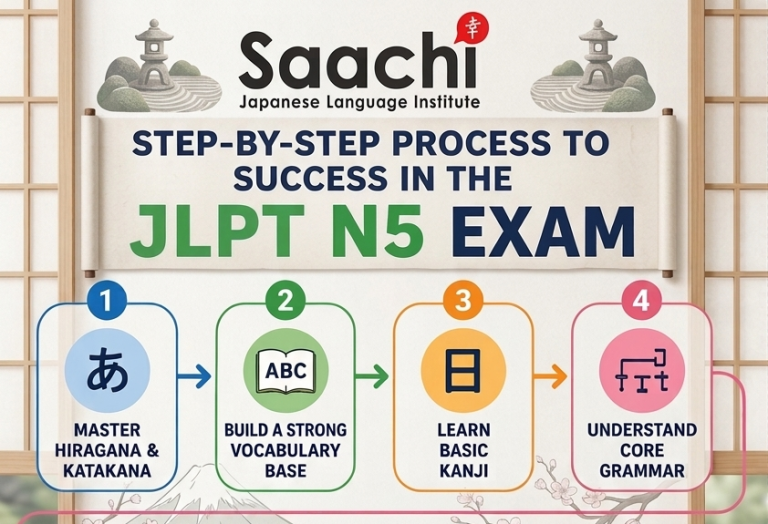

So you’ve got your N5 basics down — hiragana, katakana, the core grammar, your first hundred-odd kanji. That’s genuinely the hardest part: getting started. Now comes N4, and it’s where a lot of self-learners quietly stall — not because it’s impossibly hard, but because the study approach that carried you through N5 stops being enough.
This is a step-by-step plan to get you through N4: what it actually tests, how long it really takes, and the order to tackle things in so you don’t waste months. It’s written for Indian learners, so we’ll flag the traps that tend to catch us specifically.
Not sure you’ve finished N5 yet? Take our free level test first — it takes about ten minutes and tells you exactly where you stand.
What JLPT N4 actually tests
N4 roughly doubles everything from N5:
- Kanji: around 340 (up from ~130)
- Vocabulary: around 1,500 words
- Grammar: everyday sentence patterns — plain form, potential, giving and receiving, conditionals
- Reading: short passages, notices and simple letters
- Listening: everyday conversations at slightly-slower-than-natural speed
The big shift from N5 is this: N4 expects you to handle plain (casual) form, and to combine grammar rather than recognise single points in isolation. You move from “words in boxes” to sentences that actually flow.
How long does N4 take?
Honestly, it depends on your hours — but as a guide, N4 is around 100 hours of structured study on top of a solid N5 base. That works out to roughly:
- ~5 months at 5 hours a week, or
- ~3 months at 8 hours a week
Whatever pace you choose, consistency beats intensity. Two focused hours, four times a week, will take you further than a single six-hour Sunday cram.
The step-by-step plan
Step 1 — Make sure your N5 is actually solid
N4 builds directly on N5. If your N5 grammar is shaky, N4 will feel impossible — not because N4 is hard, but because the foundation is cracked. Be honest: can you form past, negative and て-form sentences without stopping to think? Take the free level test to confirm you’re ready. If it still says N5, spend two more weeks there first — it’ll save you months later.
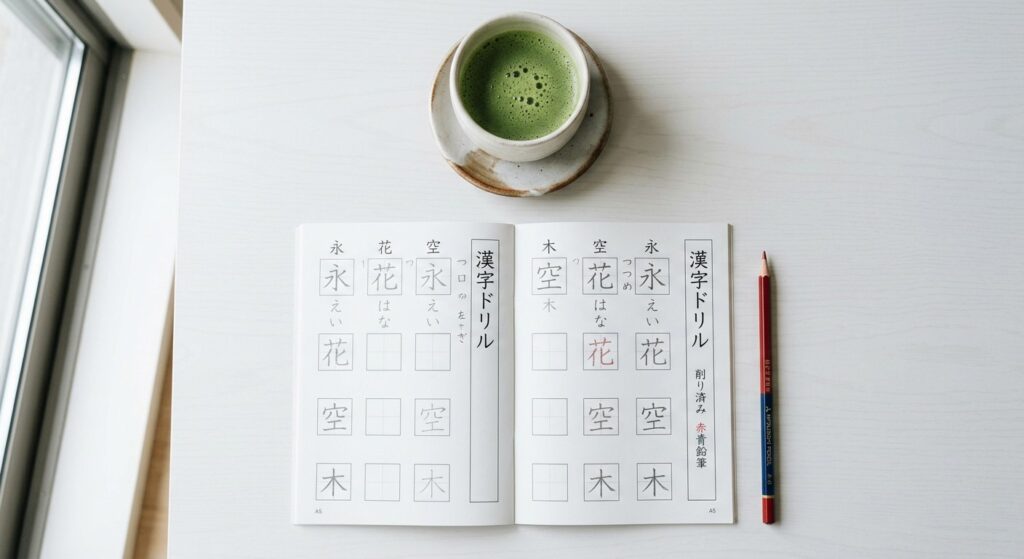
Step 2 — Kanji: 340, little and often
340 kanji sounds daunting, but it’s very manageable at ~15–20 a week. Don’t cram. Use spaced repetition (Anki works well), learn each kanji with its common readings and a word it appears in, and — crucially — read it in real sentences, not as an isolated character. Recognising 食 on a flashcard is not the same as reading 食べます in the wild.
Step 3 — Grammar: the patterns that define N4
These are the N4 grammar points that matter most: plain (casual) form, potential (〜ことができる / 〜られる), experience (〜たことがある), giving and receiving (あげる・もらう・くれる), conditionals (と・たら・ば), 〜てある / 〜ておく, and 〜なければならない. Learn each inside an example sentence, not as an abstract rule — then write two or three of your own. Grammar you can only recognise isn’t grammar you can use.
Prefer to see the grammar in action? Here’s a quick N4 grammar practice session from our own trainers:
Step 4 — Vocabulary in context
1,500 words is too many to memorise cold. Learn them in themes and inside sentences — “at the station,” “at the doctor,” “talking about plans.” Vocabulary tied to a situation sticks; a bare word list evaporates by the weekend.
Step 5 — Listening, early and every day
This is the single most-neglected skill for Indian learners, because many of us learn Japanese mainly through reading and textbooks. Don’t leave listening until the month before the exam. Even 10–15 minutes a day of N4-level audio — dialogues, slow podcasts, your textbook’s audio — trains the ear that reading never will.
Step 6 — Reading: short passages
Practise reading short notices, emails and simple passages under a gentle time limit. The N4 reading section isn’t about understanding every word — it’s about getting the main point quickly. Train that skill deliberately.
Step 7 — Mock tests before the exam
In your final month, do full, timed mock tests. They fix two things nothing else can: your pacing (N4 has a time limit that catches people out) and your exam nerves. Aim for at least three full mocks before the real thing.
Common N4 mistakes that catch Indian learners
- Leaving listening until the very end — then panicking
- Memorising kanji by rote, without readings or context
- Translating everything into English (or your first language) in your head instead of thinking in Japanese
- Ignoring plain form because textbooks start with polite form
- Cramming in bursts instead of studying a little, often
Recommended textbooks
The stack that works well for N4: Minna no Nihongo II (core), Sō Matome N4 (grammar / kanji / listening, one book each), Shin Kanzen Master N4 for a tougher grammar drill, and a Speed Master vocabulary book. You don’t need all of them — Minna no Nihongo II plus one Sō Matome book is plenty to start.
How Saachi helps you get there
Our JLPT N4 course covers roughly 100 hours and ~340 kanji — grammar, native-speaker practice, reading and listening, regular tests, and full mock tests before the exam — with Lata-sensei (JLPT N1, BJT Level 2, 18+ years of teaching) guiding you the whole way.
Not sure whether to start N4 or revise N5 first? Take the free level test and it’ll point you to the right starting place. Or book a free demo class/consultation and talk it through with a trainer.
Keep going
N4 is the bridge. Clear it, and N3 — real, usable, everyday Japanese — is genuinely within reach. Next in this series: our N3 prep guide (coming soon). And if you’re weighing up where you are, start with How to Choose the Right JLPT Level.
At Saachi, the goal is simple: help you Speak Japanese with Confidence — one level at a time.